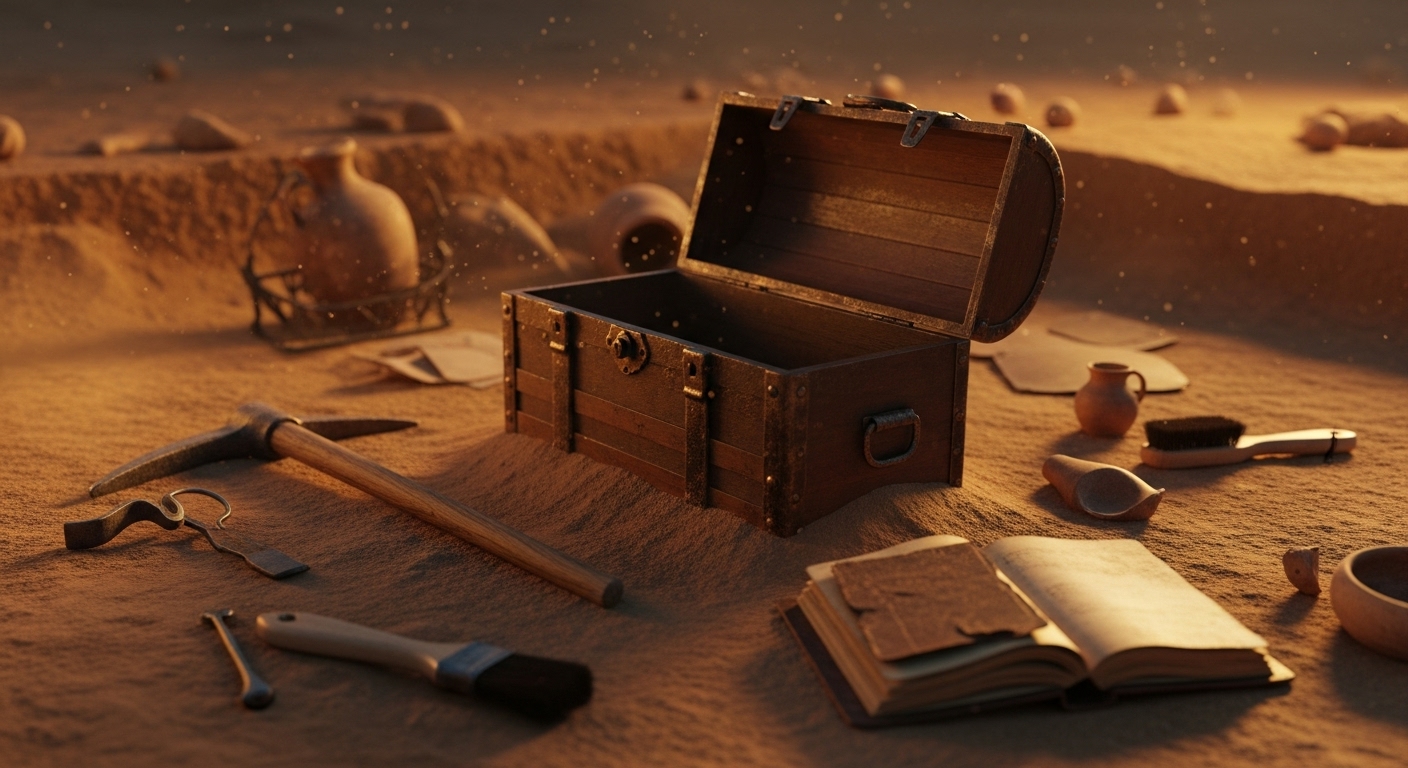
Memories Buried in the Soil: The Tale of a “Worthless” Treasure
The first rain found me at the threshold of the house I had not entered in years. Monsoon came in sheets rinsing dust from the neem leaves waking the old tiles from their chalky slumber and teasing that deep impossible smell from the ground—the perfume of wet earth that Hindi names so simply: mitti ki khushboo. It was as if the yard exhaled and with it exhaled a century.

I had come to oversee renovations. A new room was planned where the old cowshed had stood and men with spades were turning the courtyard soil loosening memory from roots and stones. At noon when the rain thinned and a watery sunlight skittered over the bricks a worker called out. His shovel had caught on something hard—not the clank of metal but the hollow ancient tap of clay.
They brought it to me palms damp with mud eyes bright from discovery: an earthen pot the kind our grandmothers sealed with cloth and hope. It was not large. Its mouth had been smeared shut with a ring of old lac now crumbling like dried blood. There were fingerprints fossilized on its shoulder—the print of the one who had buried it? Or the one who made it? Would such ordinary sanctities ever yield their names?
We broke the seal carefully. The pot gave with a reluctant sigh as if its small darkness had grown shy of light. What it contained could only disappoint a treasure hunter: no coins to change anyone’s luck no gleam of gemstones undone from necklaces. Inside lay a crestfallen inventory of lives blown elsewhere—glass bangles in broken arcs of green and pink; a rust-mottled key with no memory of its lock; two marbles one clear as raindrop one clouded blue; a slingshot bolo lacking its rubber; a scrap of red ribbon; a greasy film ticket whose ink had nearly fled; a brass coin dull as old rice water; a wooden button the stitching holes clogged with earth; one tiny clay whistle shaped like a bird; and under these wrapped in a handkerchief turned brittle a page torn from a school notebook with a childish name and date and the first halting line of a poem.
The men shrugged. Bekaar someone said—useless. Even the scrap dealer wouldn’t give more than two three rupees for the lot. He drifted away toward the hand pump and the moment tugged at me with a private gravity. My fingers sifted the pot’s contents one by one brushing off clods of soil as if I could brush time itself. Who had buried this? A child? A woman closing a chapter? Someone leaving in a hurry? Someone practicing magic? The clay bird found my palm; I blew into its tiny mouth. It did not sing. It coughed up a pale pout of dust.
Worthless treasure is what we call the things that cannot buy us a better future. But in the slope of that word—bekaar—there is a little carelessness like shooing away a fly. Value as the world teaches it is the glittering portable kind. In the bright impatient arithmetic of now a pot of bangles and a poem that never got past its first line cannot compete. But the heart runs a different accounting. It tallies belonging not profit. To the heart a key with no door is not pointless; it is a question. It asks What opened and closed here? What stayed? What left?

When I was small my Dadi kept her own earth-bound secrets. At summer’s mouth when mangoes split their skins with sugar and the sky pressed down in a glazed heat she would bring out big round-bellied jars heavy with achaar their mouths wrapped in muslin. She would paint a ring of cow-dung on the courtyard floor—ant-disguised fence—press the jars into shallow pits and smear the earth smoothly over them. “The soil is a patient aunty ” she would say patting it once for good measure. “Don’t let heat and haste ruin what time must teach.” We buried pickles in the yard and I grew up believing the ground was a trustworthy collaborator in everything that required ripening.
Then there were the older burials the ones that floated like rumors. When Partition drew its angry lines the story goes my great-grandmother buried a tin of silver coins behind the tulsi plant. She was told they’d return by the new moon. The new moon came and left without them. The coins if they ever existed fed no mouths. But the story did. The story pulled long strands of belonging into our cautious present. In that story my family is not just a quick sketch of electricity bills and ration cards; it is a village of women pressing parched lips to river water a man weighing the hinge of a door against the hinge of a promise. In that sense those coins never spent purchased the slow dear thing called identity.
I took the pot to the verandah and spread its contents on the low table. Around me the house breathed its old calendar: the fan trembled and sang of electricity’s uneven love; a kite felled by the morning rain clung to the guava tree; the neighbor’s pressure cooker hiccuped like a scolded child. One by one neighbors came to look. Their verdicts were practical and nonjudgmental in the village way. “Marbles? A boy’s mischief.” “Bangles? A girl’s stash.” “Key? Arre who knows. Locks change.” “Put it back ” said an old man with betel-stained teeth. “A buried thing has its reasons.”
It was Bimla Aunty who claimed the story. She lived two doors down a woman with a voice of gravel and clarinets and a memory that stored addresses other people considered lost. “Do you see this?” she asked lifting the oily film ticket between thumb and forefinger. “Natraj Cinema. That was at the chauraha. They showed ‘Hum Aapke Hain Koun..!’ there the whole summer of ’94. And see this bangle color? That lime-sherbet shade? That was Gudiya’s favorite.”
Gudiya. The name rang like a chime you want to catch. Of course there had been a Gudiya here; villages without a Gudiya were like monsoons without thunder. “Her father was the school’s third-grade master ” Bimla continued. “He cut his hair like a film hero. They left for Delhi when the quakes came remember? The house cracked along the western wall like a paratha. She must have been twelve thirteen. We saw her once after that years later. She came in an auto wearing a red shawl tall as any city girl but with dirt still in her laughter. We stood right here and gossiped for an hour. Then she went to the yard and poked the earth with a stick like a chicken. She dug in three places frowning. I asked ‘What are you hunting?’ She said ‘A pot I buried. My khazana. It held everything that was mine.’ She laughed while she said it but when she stood up empty-handed I saw something fold in her face.”

I looked at the date on the notebook paper written in the sort of careful drama girls reserve for titles and new pens: 12 August 1993. And under it a name in looping letters that indeed read Gudiya Sharma and then the first line of a poem. It had been crossed out started again crossed out once more. The last attempt remained: “When the sky forgot its jar of blue over our small house…”
You could build a whole childhood from that line. A kitchen with coriander drying in a sieve near the window a mother humming a koel’s borrowed melody a father tapping chalk against a blackboard the words “Explain this” smelling faintly of chalk and impatience. Then the earth heaves a ridge appears in the wall like an eyebrow men squint at it with folded arms and declare it “manageable ” the loan does not come and so the family goes to a rented room in Delhi that is both smaller than the idea of home and larger than the unknown they feared. They give away their goats. They lock the door. The key becomes a problem. A girl takes a pot and buries her empire of tin and glass and paper and air believing that the soil who is a patient aunty will keep it safe until she can come back to claim it.
Not all returns meet their endpoints. Not all keys find their locks. Not all poems find their middles. What we call bekaar khazana is often the residue of a plan that had to be shelved because another plan barged in wearing urgency like a uniform. In physics they say nothing is really lost; forms turn to other forms. Heat becomes light becomes motion becomes warmth in a kitchen. In human rooms what is lost becomes if we’re lucky story.
I picked up each item again and turned it in my hand until it had a little life. The marbles summoned afternoons of eyes narrowed to a hunter’s squint knuckles white dust speck bounty. The slingshot conjured mango thefts in the neighbor’s orchard whispers quick feet. The ribbon resurrected a braid and the fingers that tamed it. The clay whistle carried a monsoon procession with paper boats and rain thick enough to erase a street’s remembered arguments. Even the brass coin valueless in market terms became a passport stamp from a journey taken to the candy man’s shop—booty exchanged for sweet limes which made your tongue go quiet with tart.
These small things apparently trivial enact a profound rebellion. In a time that asks us to streamline to declutter to optimize they are clutter incarnate—and yet they are exactly where meaning lives. We bury what is inconvenient to lust for what resists display. We bury to keep safe. We bury to forget. We bury because the body knows the ritual of returning to the ground calms us. Mothers bury the placenta beneath a tulsi tree whispering prayers for the child to take root. Farmers bury last season’s grit trusting seeds to do what seeds know. Children bury their unrealized kingdoms as if to tell the soil: “Hold this until I learn to hold myself.”
If the world had left me alone with my pot perhaps I would have polished each object and arranged them in a shadow box a museum of reliquaries above my desk. Perhaps I would have written to all the Gudiya Sharmas of the alumni archives asking if they had once buried their sky-blue. But a village never quite leaves you alone. Two girls from next door wandered in with a missing-duck energy took one look and sat cross-legged on the floor as if called to class. “Didi why bury such boring things?” one asked. “I would bury my favorite phone ” said the other with a seriousness that made me laugh.
“Phones live badly underground ” I said. “But what would you bury that does not have a charger?”
They thought. The first said “The kite my brother wrote my name on.” The second “The pebble I found that looks like a heart.” Both choices I wanted to tell them had already grown roots in their sentences.
That afternoon we held an unlikely ceremony. It was not an official thing not as neat as a time capsule buried by people who know they will be discussed in newsletters later. In the hole the workers had already made when they found the pot I laid the objects back—Gudiya’s marbles key ribbon whistle coin. They had seen light and air for an hour; they had told their story; now I wanted them to return to their old friend and resume the long slow work of becoming part of it. With them we placed the two girls’ offerings: a pink kite tail and a heartish pebble. I added a note not sealed with lacquer simply folded in plastic against damp. It said:
“If you find this add something bekaar that you love. Then put it back. Leave the story fatter than you found it.”
Bimla Aunty laughed at me and called me a sentimental fool. The old man with the betel leaves nodded and said the right things people say at funerals or births or any significant moment disguised as ordinary: “Thik hai. This is good.”
You could ask why I didn’t try to find Gudiya or why I didn’t keep the things and guard them against the slow dissolve that is every object’s fate. The truth is sometimes the most faithful way to honor a story is not to display it but to deepen it. Museums are indispensable yes; archives rescue what flood and fire and human greed would happily erase. But not everything wants a glass case. Some stories want their old rooms. They want sun baked into their lids. They want darkness and worms and the soft drum of footsteps above. They want to be bumped by the roots of a gulmohar and the roots to say “Ah there you are.”
By evening the rain returned. It stitched a bright new hem to the horizon and played on the verandah like a tabla trainee. The yard filled again with that smell ancient and fresh as if a god had crushed a leaf and said “Remember this.” The pot’s resting place sat smooth and almost unnoticeable. People walked over it. A cat tested it with velvet paws and finding no protest proceeded to practice boredom majestically. Somewhere under there a clay bird lay against a ribbon and a coin leaned into a pebble that if squinted at kindly would agree to being a heart.
Standing there I realized that bekaar khazana is a kind of grammar. It teaches how to hold nouns lightly and verbs firmly. It suggests that the value of a thing is not in its shine but in the lives it remembers you to. It argues against the quick fix and for the long gaze. It says: you belong to a place that remembers your footsteps even after you have gone soft with forgetting. It says: do not measure your days only in achievements synced to the cloud. Measure them also in the soil’s equal but opposite memory—the way it swallows curates and one day returns.
Later when the renovations were done and the new room smelled of wet cement and new beginnings I drew a small map on the last page of my notebook. Not to reveal the buried spot to anyone who might want to pry it open for novelty’s thrill. Rather to remind myself that a yard holds more than two mango trees and a hand pump. It holds agreements with time. It holds treaties with people you may never meet. It holds a girl’s abandoned poem clause: “When the sky forgot its jar of blue over our small house…” A half-line that like a seed contains an entire future inside but trusts the soil to finish the sentence.
Mitti mein dafta yaadein. The phrase itself tastes like a ritual like something you do before traveling after grieving in the quiet between two daily chores. Some of what we bury we bury because it is too sharp to hold. Some because it is too tender to expose. Some because we are practicing what we will one day ask of our bodies: to return what we have borrowed from the earth in a spirit of radical gratitude.
And in that return nothing is truly lost. The pot breaks down. The ribbon fades. The marbles wait centuries longer than any of us. The story fattens. A child yet unborn will dig here hunting something else and find instead a parliament of small things that tell her: your life too is precious beyond proof. What is bekaar to the market is the very currency by which a place pays attention to you. And if the sky ever forgets its jar of blue over your small house the soil will remember and when you crack it open it will rise like a perfume and say: Welcome back.